LEGAL GUIDANCE WHEN THE STAKES ARE PERSONAL

Immigration and personal injury matters can affect your freedom, your family, your health, and your future. I provide direct, focused legal representation with clear guidance at every stage of the process.
When you hire my firm, your case is not passed from one unfamiliar person to another. I remain personally involved, explain what is happening, and work with you to develop a strategy based on your individual circumstances.
PERSONAL INJURY
When someone else’s negligence causes an injury, you should not have to face the insurance companies alone. I help injured clients preserve evidence, document their losses, obtain appropriate medical treatment, and pursue maximum compensation available under Texas law.
An injury can cause medical expenses, lost income, pain, physical limitations, and uncertainty about the future.
I investigate how the incident occurred, identify potentially responsible parties and insurance coverage, and build the evidence necessary to pursue the claim.
CAR ACCIDENTS
A motor-vehicle collision can result in physical injuries, medical expenses, lost income, property damage, and lasting disruption to everyday life.
We investigate the collision, preserve available evidence, communicate with the insurance companies, document the client’s injuries and losses, and pursue a fair resolution of the claim.

Commercial Vehicle Accidents
Collisions involving 18-wheelers, commercial trucks, delivery vehicles, and company vehicles may involve several responsible parties.
Depending on the circumstances, those parties may include the driver, employer, vehicle owner, contractor, maintenance provider, or another business.
We investigate the collision, preserve time-sensitive evidence, evaluate the available commercial insurance coverage, and pursue claims against the appropriate parties.

Premises Liability
Businesses and property owners may be responsible when an unreasonably dangerous condition causes an injury and the requirements for a premises-liability claim are satisfied.
These cases may involve unmarked wet floors, unsafe walkways, inadequate maintenance, falling objects, defective conditions, or other hazards.
We evaluate notice, responsibility, surveillance footage, incident reports, witnesses, and the injuries caused by the condition.

DOG BITES & ANIMAL ATTACKS

Dog bites and animal attacks can cause puncture wounds, scarring, infection, nerve damage, emotional trauma, and other serious injuries.
We investigate the circumstances of the attack, the animal’s known history, the owner’s knowledge and conduct, applicable local requirements, and available homeowner’s or renter’s insurance coverage.
CATASTROPHIC INJURIES & WRONGFUL DEATH
Severe injuries can permanently affect a person’s health, mobility, independence, ability to work, and family life. These matters may involve surgery, disability, future medical care, or the tragic loss of a loved one.
We carefully document the full effect of the incident and pursue the compensation available for the resulting financial and personal losses.

oTHER NEGLIGENCE CLAIMS
Not every injury fits neatly into one category. If a person, business, property owner, contractor, or another party caused harm by failing to exercise reasonable care, a legal claim may exist.
We review the facts, identify potentially responsible parties and available insurance coverage, and determine whether the circumstances support further legal action.

immigration law
Your immigration case is about more than forms and paperwork. It can determine whether your family remains together, whether you can continue building your life in the United States, and whether you are protected from removal. The decisions made now can carry consequences for years.
Deadlines, immigration history, prior entries, criminal matters, and even small inconsistencies can affect the outcome. I provide careful, direct representation to identify the available options, anticipate potential problems, and present each client’s case with the preparation it deserves.
Explore the services below to learn how I may be able to help, then schedule a consultation to discuss your circumstances and next steps.
Family-Based Petitions & Adjustment of Status

-
U.S. citizens may petition for certain immediate relatives:
• A spouse
• An unmarried child under 21
• A parent, when the U.S. citizen is at least 21Immigrant visas are generally immediately available in these categories. A relative already inside the United States may also qualify to apply for adjustment of status, depending on the person’s entry, immigration history, admissibility, and other circumstances.
I help families establish the qualifying relationship, prepare the family petition and green-card application, organize financial and supporting evidence, and prepare for the USCIS interview.
-
Family-preference immigration may be available for:
• Spouses and unmarried children of lawful permanent residents
• Adult or married children of U.S. citizens
• Brothers and sisters of U.S. citizens who are at least 21Unlike immediate-relative cases, these categories are subject to annual visa limits. The beneficiary may need to wait until the priority date becomes current before completing the green-card process.
I identify the correct family category, prepare the Form I-130 petition and relationship evidence, monitor visa availability, and guide the family through each stage of the case.
-
A family petition begins the process, but it does not by itself grant lawful status or a green card. The next step generally depends on where the relative is located and whether that person qualifies to complete the process inside the United States.
• Adjustment of status may allow an eligible person inside the United States to apply for permanent residence through USCIS.
• Consular processing is generally used when the relative will apply for an immigrant visa through a U.S. consulate outside the United States.
Before filing, I review the person’s manner of entry, immigration history, criminal history, prior applications, unlawful presence, and possible grounds of inadmissibility. This evaluation helps determine the appropriate process and whether a waiver or another legal strategy may be required.
REMOVAL PROCEEDINGS & DEPORTATION DEFENSE
-
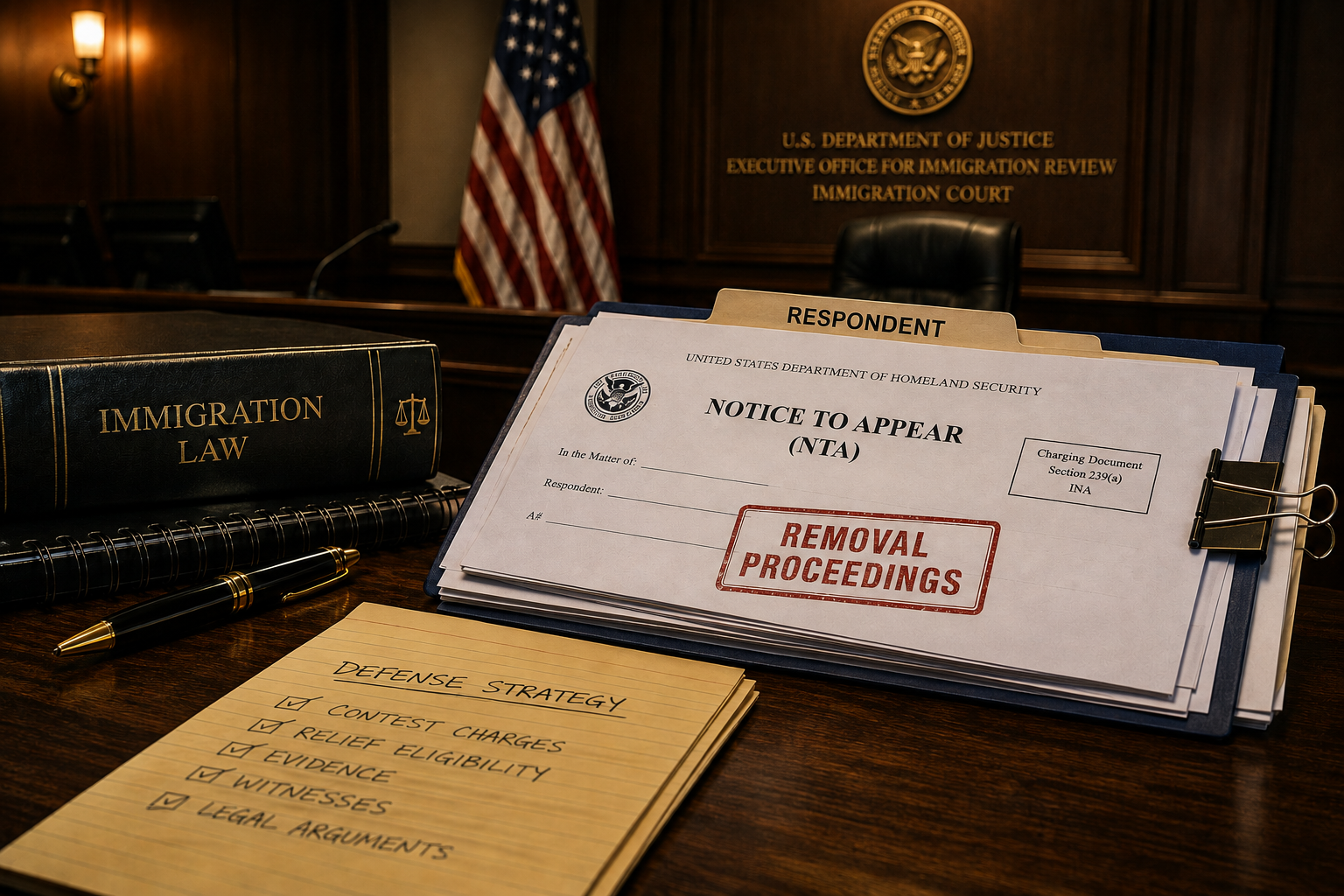
Removal proceedings generally begin when the Department of Homeland Security files a Notice to Appear with the immigration court. This document identifies the factual allegations and legal charges the government claims make the person removable from the United States.
At the initial master-calendar hearings, the immigration judge addresses representation, the government’s charges, possible defenses or applications for relief, filing deadlines, and future hearing dates.
I review the Notice to Appear, immigration and criminal history, government evidence, and possible procedural or legal challenges before advising the client how to respond to the allegations and charges.
-
Being placed in removal proceedings does not necessarily mean that removal is inevitable. Depending on the person’s history and circumstances, one or more defenses may be available.
Potential forms of relief may include:
• Family-based adjustment of status
• Cancellation of removal
• Asylum, withholding of removal, or protection under the Convention Against Torture
• Waivers of inadmissibility or removability
• Voluntary departure or another form of relief authorized by lawI evaluate the client’s entry and immigration history, time in the United States, family relationships, criminal record, prior applications, and fear of returning to determine which defenses should be pursued.
-
An individual hearing is the immigration-court trial at which the respondent presents the application for relief. The immigration judge may consider testimony, documents, witness statements, expert evidence, hardship evidence, and country-condition information. The government may oppose the application and question the respondent and other witnesses.
A successful case requires more than submitting immigration forms. The evidence must clearly establish every required legal element and explain why the immigration judge should grant relief as a matter of discretion when discretion is required.
I prepare the applications and legal arguments, organize exhibits, develop witness testimony, prepare the client for questioning, respond to the government’s position, and represent the client through the immigration judge’s decision.
Immigration DETENTION & BOND
-
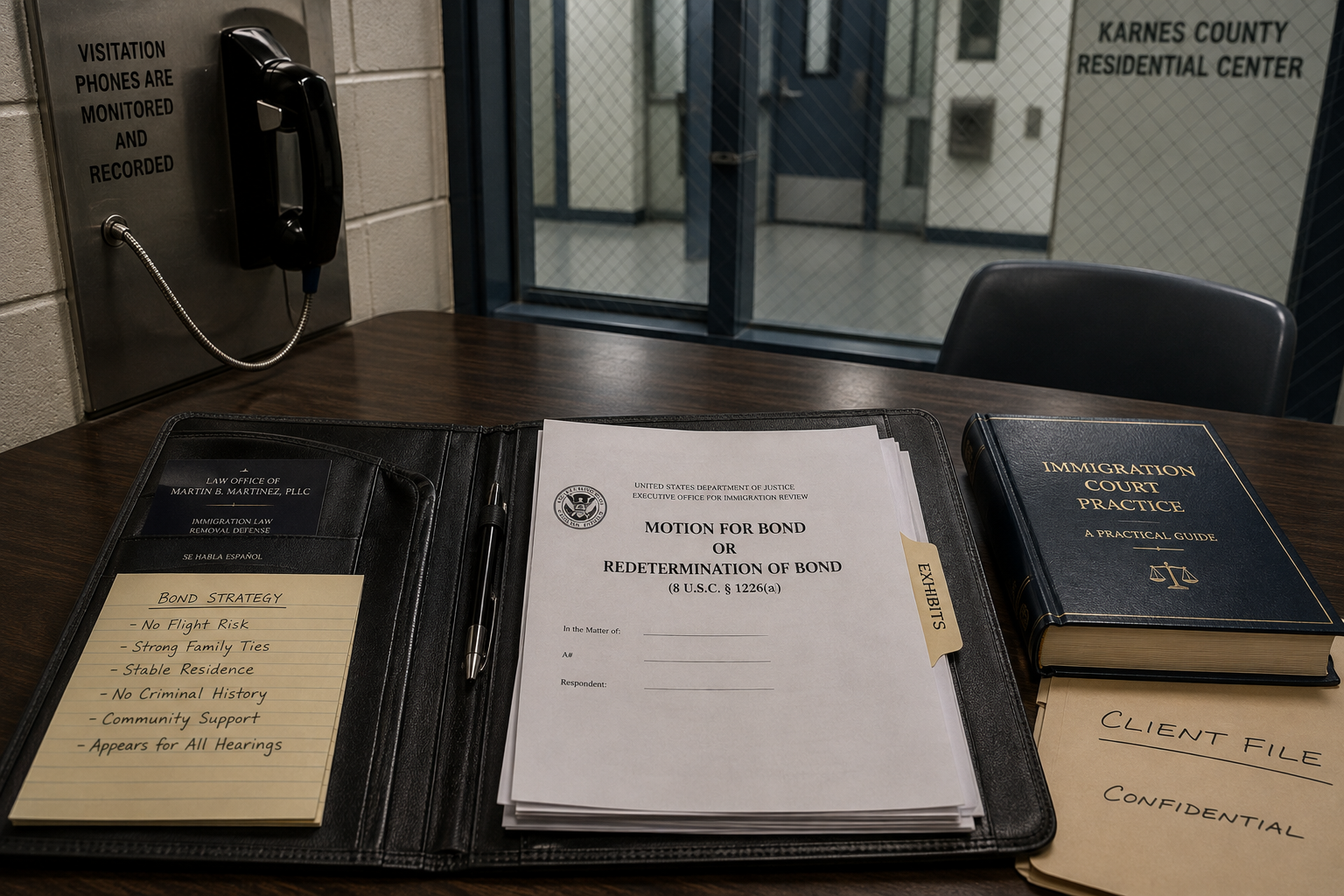
When a person is taken into immigration custody, the first steps are determining where the person is detained, identifying the immigration court with jurisdiction, and reviewing the reason for detention.
A detained immigration case can move quickly. Important information includes the person’s A-number, manner of entry, immigration history, criminal record, prior removal orders, family ties, and any pending applications or possible defenses to removal.
We review the custody and court records, communicate with the detained client and authorized family members, evaluate possible relief from removal, and determine whether release through bond or another procedure may be legally available.
-
The Department of Homeland Security initially decides whether a detained person will be released, held without bond, or given a bond amount. In qualifying cases, an immigration judge may review that decision and determine whether release is appropriate.
Not every detained person is legally eligible for an immigration-court bond hearing. Eligibility may depend on the person’s manner of entry, custody classification, criminal history, prior removal orders, and the particular detention authority being used.
I analyze whether the immigration judge has authority to review custody, request a bond hearing when available, and address any claim that the person is subject to mandatory detention or another restriction on release.
-
At a bond hearing, the immigration judge considers whether the person presents a danger to people or property, a flight risk, or a threat to national security. The judge may also consider the person’s immigration and criminal history, family relationships, community ties, proposed residence, employment history, and possible relief from removal.
Helpful evidence may include:
• Identification and immigration records, especially proof of lawful entry
• Proof of a stable residence and responsible sponsor
• Birth and marriage certificates establishing family ties
• Employment, tax, school, medical, or community records
• Letters of support and certified criminal-court dispositionsWe prepare the bond request, organize the supporting evidence, prepare the client and available witnesses, and advocate for release on recognizance or a reasonable bond when legally available. Release from detention does not end the removal case; the person must continue attending court and complying with all release conditions.
ASYLUM & PROTECTION FROM REMOVAL

-
Asylum may be available to a person who has suffered persecution or has a well-founded fear of future persecution because of:
• Race
• Religion
• Nationality
• Political opinion
• Membership in a particular social groupThe feared harm must be connected to at least one protected ground. Persecution may be committed directly by the government or, in certain circumstances, by individuals or organizations the government is unable or unwilling to control. This area of immigration law has been recently attacked by the Trump administration as a result many complex legal issues have emerged for aslyum applicants.
We evaluate the applicant’s experiences, the identity and motives of the persecutor, government involvement or response, internal-relocation issues, and any facts that could affect eligibility.
-
An asylum application generally must be filed within one year of the applicant’s last arrival in the United States. Exceptions may apply when changed or extraordinary circumstances explain a delayed filing, but those exceptions must be properly documented.
A person who is not in removal proceedings may apply affirmatively through USCIS. A person whose case is before an immigration judge generally applies defensively in removal proceedings.
An asylum case may require:
• Form I-589 and a detailed personal declaration
• Identity and immigration records
• Evidence of threats, injuries, reports, or past persecution
• Witness statements and available corroborating documents
• Reliable country-condition evidenceI prepare the application, develop the client’s declaration and supporting evidence, address filing-deadline concerns, and prepare the client for the asylum interview or immigration-court hearing.
-
A person who does not qualify for asylum may still be eligible for another form of protection.
Withholding of removal generally requires showing that the person’s life or freedom would more likely than not be threatened because of race, religion, nationality, political opinion, or membership in a particular social group.
Protection under the Convention Against Torture requires showing that the person would more likely than not be tortured by, at the instigation of, or with the consent or acquiescence of a public official or another person acting in an official capacity. CAT protection does not require the torture to be connected to one of the five asylum grounds.
These protections differ from asylum and do not provide all the same immigration benefits. I evaluate each available form of protection and develop the testimony, corroborating evidence, and country-condition record needed to establish the applicable legal requirements.
BIA & AAO APpeals

-
Immigration appeals are handled by different appellate bodies depending on which agency issued the original decision.
The Board of Immigration Appeals, or BIA, primarily reviews decisions issued by immigration judges and certain decisions made by the Department of Homeland Security. An appeal from an immigration judge generally requires Form EOIR-26 to be received by the BIA within 30 calendar days of the oral decision or the mailing of the written decision.
The Administrative Appeals Office, or AAO, reviews eligible decisions issued by USCIS involving certain immigration petitions and applications. The USCIS denial or revocation notice should identify whether an appeal is available, the required form, where it must be filed, and the applicable deadline.
I identify the correct appellate authority, evaluate whether the decision may be appealed, preserve the filing deadline, and clearly identify the legal and factual issues requiring review.
-
An appeal requires more than disagreeing with the result. The appellate submission must identify specific errors and explain why the decision should be reversed, withdrawn, or returned for further consideration.
Potential appellate issues may include:
• Applying the wrong legal standard
• Misinterpreting the governing statute or regulations
• Overlooking or improperly weighing important evidence
• Making unsupported or clearly erroneous factual findings
• Failing to provide a fair opportunity to present the case
• Abusing discretion in denying the requested reliefBIA and AAO appeals follow different procedures and standards of review. I examine the decision, filings, evidence, hearing record when applicable, and controlling legal authority before preparing a focused appellate brief requesting the appropriate remedy.
-
An appeal on the merits asks the appropriate appellate authority to review an unfavorable immigration decision for legal, factual, or discretionary error. The appeal may challenge the application of the wrong legal standard, unsupported factual findings, failure to consider important evidence, procedural unfairness, or an abuse of discretion.
A motion to reopen generally asks the agency or immigration court to consider material facts or evidence that were not previously available. A motion to reconsider argues that the existing decision contains a specific error of law or fact based on the record already presented.
These proceedings involve strict filing deadlines, numerical limitations, and procedural requirements. Filing an appeal or motion does not stop removal in every situation. When an enforceable removal order exists, a separate stay of removal may be necessary to protect the client while the matter is pending.
I review the decision and underlying record, determine the appropriate appellate or post-decision remedy, prepare the supporting brief and evidence, and evaluate whether emergency stay relief should also be requested.
CITIZENSHIP & NATURALIZATION

-
Many lawful permanent residents may apply for naturalization after holding permanent-resident status for at least five years.
Applicants generally must establish:
• Continuous residence in the United States for five years
• Physical presence for at least half of that period
• Residence within the applicable state or USCIS district
• Good moral character
• Basic English ability and knowledge of U.S. history and government, unless an exception applies
• Attachment to the principles of the Constitution and willingness to take the Oath of AllegianceBefore filing, I review the applicant’s immigration history, international travel, taxes, arrests or criminal matters, child-support obligations, voter-registration history, and the circumstances surrounding the original green-card application. I prepare Form N-400 and supporting evidence and help the applicant prepare for the USCIS interview and naturalization examination.
-
Certain lawful permanent residents may apply for naturalization under the three-year rule based on a qualifying marriage to a U.S. citizen. The current U.S.-citizen spouse does not necessarily have to be the person who originally petitioned for the applicant’s green card.
The applicant generally must establish:
• Lawful permanent-resident status for at least three years
• Marriage to and marital union with the same U.S.-citizen spouse during the three years immediately before filing
• U.S. citizenship of that spouse throughout the required three-year period
• Continued marriage to the U.S.-citizen spouse through naturalization
• Compliance with the applicable residence, physical-presence, good-moral-character, English, and civics requirementsI review the applicant’s complete immigration and marital history, confirm eligibility under the three-year rule, prepare Form N-400 and the supporting evidence, and help the applicant prepare for the USCIS interview and examination.
-
Some individuals acquire U.S. citizenship at birth or automatically obtain citizenship after birth through a U.S.-citizen parent. Eligibility depends on the law in effect at the relevant time and may involve the person’s date of birth, the parent’s citizenship and physical presence, lawful permanent-resident status, age, residence, and legal and physical custody.
Form N-600 allows an eligible person to request a Certificate of Citizenship as official proof of citizenship. The certificate does not create citizenship; it documents citizenship that was already acquired or derived under the law.
Evidence may include:
• The applicant’s birth certificate and permanent-resident records
• The parent’s birth, naturalization, or citizenship certificate
• Proof of the parent-child relationship
• Marriage, divorce, custody, adoption, or legitimation records
• Evidence of residence and physical or legal custodyI analyze the citizenship laws applicable to the person’s history, determine whether citizenship was acquired or derived, prepare Form N-600 and supporting evidence, and address requests for additional evidence or interview preparation.
LET’S DISCUSS YOUR CASE
Every case begins with understanding your circumstances and identifying the available next steps. Tell me briefly about your immigration or personal injury matter, and my office will contact you to discuss scheduling a consultation.
Se habla español.